




To attract potential customers to your e-commerce site and turn them into loyal ones, you need an effective SEO strategy. The higher your site appears in search results, the more likely it is to be visited by people interested in your products or services. But how do you get there? Here are the main steps to follow to get your e-commerce site to rank well.
How to get your e-commerce site to rank well
Search engines favour well-structured and optimised sites. To appear at the top of search engine results pages (SERPs), you need to follow certain best practices. For example, Google favours sites organised into categories and subcategories with well-structured HTML tags, such as an H1 for the title, H2s and H3s for subheadings, and a meta description.
Choose a fast, responsive e-commerce site
It is important that your e-commerce site displays correctly on mobile. To optimise UX (User eXperience) and improve the SEO of your e-commerce site, follow these few basic rules:
- Page loading speed
According to Google Analytics data, 70% of mobile users abandon a website if loading time exceeds 3 seconds and 53% of visits to a mobile website are abandoned if loading time exceeds 6 seconds.
Make sure pages load quickly to avoid losing visitors. Use tools such as GTmetrix or PageSpeed Insights to test your site’s speed.
- Responsive site
Your site must be mobile-friendly to adapt to smartphones, which Google now favours for ranking. Indeed, Google’s algorithm relies on the mobile version of an e-commerce site to rank it. If your site is not responsive, you risk losing visibility in search results.
- Technical design
The choice of CMS (WordPress, Joomla, Drupal…) and of payment platform has a real impact on your e-commerce site’s performance.
Research the right keywords
The first step of good SEO is choosing the keywords you want your custom online shop to rank for in search engines. This step may seem simple, but it is actually more complex. To guide you through the process, here are some key tips:
Think like your users and customers
The first step is to put yourself in your potential customers’ shoes and see things from their perspective. What keywords would they use to search for your products or services? What questions would they ask themselves?
Ask yourself these questions to identify relevant keywords:
- What terms do your customers use to describe your products and services?
- What questions do they frequently ask themselves?
- What would they type into the Google search bar to find what you offer?
Use Google Suggest
Google Suggest is a valuable tool to identify popular keywords relevant to your business. It offers real-time query suggestions related to your search, giving you an overview of search trends and the terms internet users use most.
Here is how to use Google Suggest to find your keywords:
- Start by typing a general keyword related to your business into the Google search bar.
- Look at the suggestions that appear as you type.
- Analyse the related terms and phrases suggested by Google Suggest.
- Refine your search using more precise and relevant keywords.

Other keyword research tools
Besides the one mentioned above, several tools help you find relevant keywords and enrich your semantic field, such as Ubersuggest, Semrush, YouTextGuru and others.
Optimise your meta tags
Also take care when writing your meta tags: title and description. These tags are displayed directly in search engine results. Search engine algorithms (Google, Bing, Yahoo…) take them into account when analysing and ranking your e-commerce site.
Set up a link-building strategy
Internal linking makes it easier for search robots to navigate and improves the user experience. It offers many benefits such as better indexing, smooth navigation and keeping visitors on your e-commerce site …
Tip: Use descriptive and varied link anchors and add 3 to 4 links per page.
External linking, or backlinks, is also important. An e-commerce site that ranks well in search results is, first of all, a popular site. Google assesses a site’s popularity mainly based on the quantity and quality of external links pointing to it.
Tip: To get these links, we recommend contacting bloggers and influencers in your sector so that they publish articles about your shop on their sites. You can also build partnerships with complementary sites or online shops.
Finally, listing your shop in directories can be useful, provided you check the quality of those directories.
Create a Google Business Profile (Google My Business)
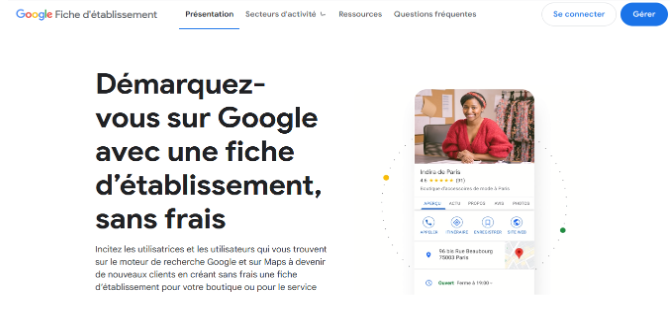
Since 2009, Google My Business has given businesses the chance to stand out in search results. This free service lets owners create a complete, informative profile for their business, visible on Google Maps and in Google search results.
While creating a Google My Business profile has no direct impact on your ranking, it has many undeniable benefits for your business’s visibility:
- Detailed presentation of your business: name, address, opening hours, website, photos, descriptions, etc.
- Appearing on Google Maps: your business will be located and visible on Google’s interactive map, attracting local customers.
- Dedicated Products tab: showcase your key products directly in your profile, increasing their visibility.
- Clickable action buttons: add “Learn more” buttons to send users to the matching product pages.
- Customer interactions: encourage customer reviews, answer questions and engage directly with your audience.
Optimise your e-commerce site’s images for SEO

SEO optimisation of images and photos is often neglected. Yet this work is essential to attract potential traffic from “Google Images”. It is particularly valuable in sectors where visuals matter most, such as interior design, photography or fashion.
Here are the best tips for optimising your images properly:
- Rename image files
Avoid giving your images generic names such as DN 5248.jpg. A name like that is not relevant for SEO and gives search engines no clue about your site’s content. Ideally, rename your files to include strategic keywords separated by hyphens.
- Add alt text to images
Search engines use alt text (the ALT attribute) to better understand your images and your site’s content. So write the alt text as a descriptive sentence rather than a simple list of keywords.
- Write a caption
It is also beneficial to optimise your images and photos by adding a caption in the form of a descriptive sentence.
Call in a professional
If you don’t have the time or the skills to optimise your e-commerce site yourself, you can call on an agency like AR Digital. We can help you set up an effective, tailored SEO strategy to boost your e-commerce site’s visibility. Get in touch: hello@ardigital.eu
CONCLUSION
To conclude, your online shop will gain visibility in search engine results if you apply these steps. A well-ranked e-commerce site increases the visibility of your products and therefore boosts your sales.