





Are you used to using Google for your searches? Perhaps it is time to explore other alternatives? Searching online has become a daily habit for almost everyone. In 2024, there is a wide range of search engines, each with its own features and target audience. Here is a closer look at the top 8 most widely used search engines right now.
1. Google: the undisputed giant

Google clearly dominates the web market with 91.54% market share. Its search engine, easy to use thanks to its advanced algorithms and many features, is the preferred search tool for most users. Whether you are looking for specific information, images or videos, Google gives you fast, accurate results.
2. Bing: Microsoft’s challenger
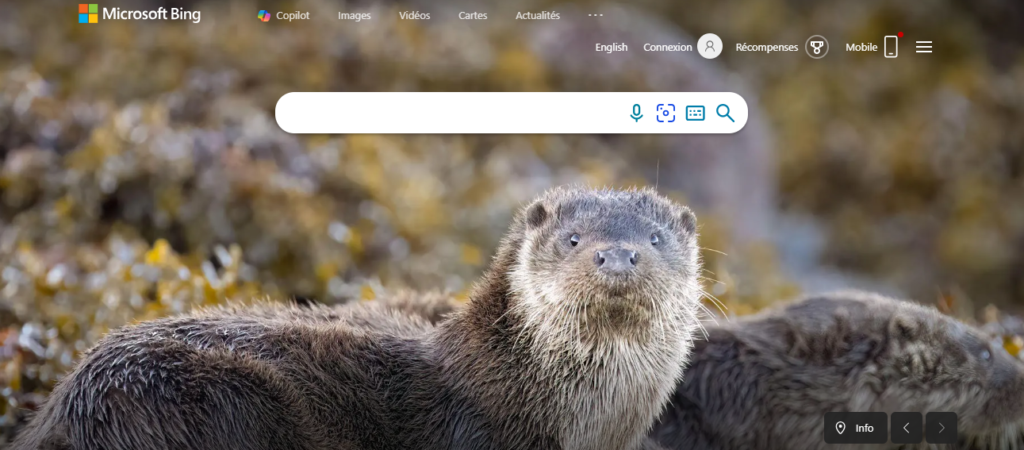
Behind the Goliath that is Google, Microsoft’s Bing positions itself as the serious challenger. It claims a global market share of 3.19%. This search engine stands out for its native integration with Windows products, making its features easy to access for users of the brand.
Bing also stands out for its advanced image search, offering a rich and immersive visual experience. If you are looking for an impressive wallpaper or an illustration for your next creative project, Bing will meet your visual expectations perfectly.
3. Yahoo!: a veteran still around
Far from the memories of the youngest, Yahoo once ruled the web, even surpassing Google in popularity. Created well before its rival, Yahoo enjoyed a meteoric rise, sitting at the top of the digital landscape for many years.
However, time is a merciless opponent. A victim of its sometimes hesitant strategy and of its competitors’ constant innovation, Yahoo gradually lost ground. Today it holds 1.23% of the global market.
In 2000, an attempt to buy Google, then young and promising, failed. Six years later, it was the turn of Facebook, which was growing fast at the time, to slip away from under Yahoo’s nose. In 2008, Microsoft came dangerously close to buying Yahoo for the colossal sum of $47 billion. But in the end, it was Verizon that took over the giant for a much more modest amount: $4.8 billion. Despite these blows and its relative decline, Yahoo has not disappeared. Its story is an ode to the endless upheavals of the digital world. A fallen giant, certainly, but one that remains an essential player on the web, showing remarkable resilience in the face of market ups and downs.
4. Baidu: the Chinese champion

Baidu is a search engine that stands out for its specialisation in Mandarin queries. It dominates the Chinese market and holds 0.93% of the global market. It is among the most visited sites in the world.
In line with search engine standards, Baidu presents varied results in response to user queries, including website links, news articles, images, videos and stock market data.
Thanks to a partnership with Microsoft, Baidu can answer queries in English. Besides its search engine, Baidu offers several other online services such as: an encyclopaedia (Baike),
- Navigation maps (Baidu Maps)
- A discussion forum (Tieba)
- A question-and-answer platform (Zhidao).
Like all Chinese companies, Baidu complies with government directives, which results in filtering of search results and censorship of certain sensitive topics. Baidu is available on all web browsers as well as on the App Store and Google Play.
5. Yandex: the Russian search engine
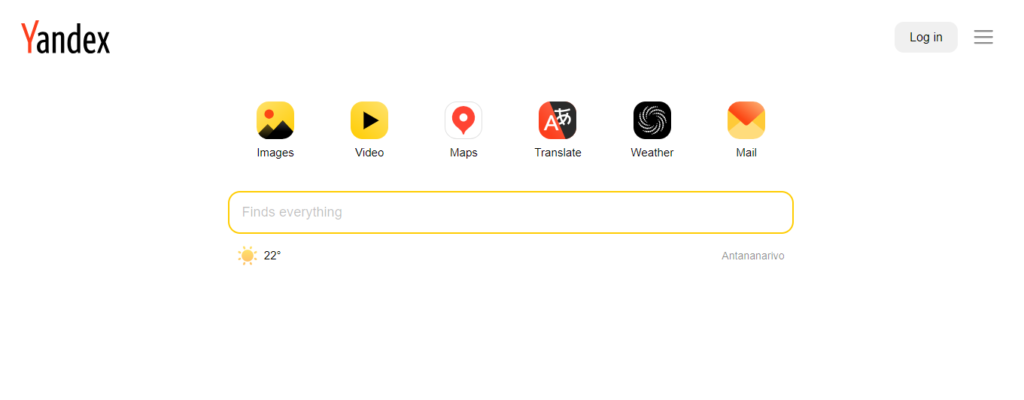
Founded before Google in 1997, Yandex is the favourite search engine of Russian internet users, with 1.78% of the global market share. Its simple, intuitive interface, along with complementary services such as mapping and instant messaging, make it a popular choice in Russia.
Yandex offers features similar to Google’s: video search, image search, translation and more. In 2024, it was sold for $5.2 billion against the backdrop of the war between Russia and Ukraine. The acquisition got a lot of attention.
6. DuckDuckGo: a privacy paradise
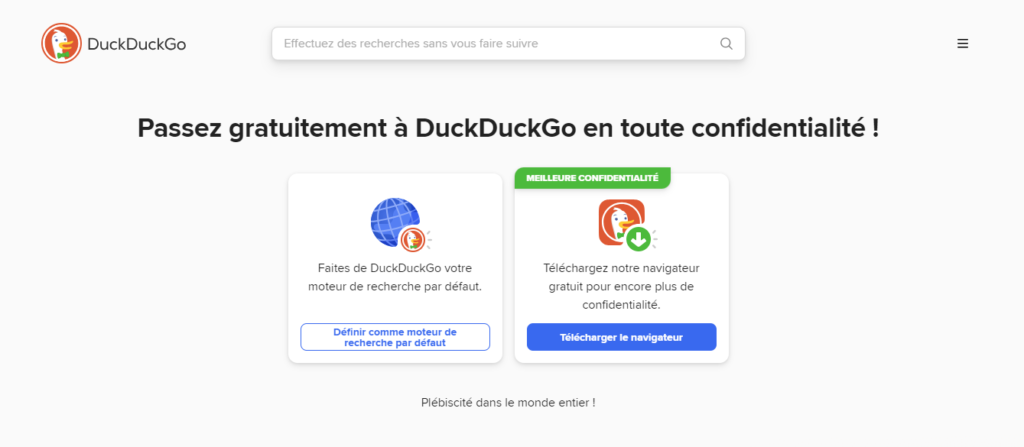
For those who place great importance on protecting their privacy, DuckDuckGo is an interesting alternative.
Launched in 2008 and holding 0.55% of the global market, DuckDuckGo is a search engine focused on privacy. It guarantees an online experience without tracking or collection of personal data. It emphasises anonymous search. Unlike other engines, it provides unfiltered results to all users. Its business model relies on advertising and affiliation. Incidentally, the search engine’s motto is: “The same internet, with more privacy.”
DuckDuckGo offers several features to protect users’ privacy:
- Blocking of hidden trackers and identification of advertising networks.
- Stronger security by favouring encrypted connections.
- Access to private search for sensitive information.
- Analysis of privacy policies thanks to a partnership.
It is compatible with the main browsers, available as a Chrome extension and as an app on Google Play and the App Store, although the web extension is only in English.
7. Brave Search: the promising newcomer

Launched in 2020 by Brave, a privacy-focused web browser, Brave Search is quickly gaining popularity. It stands out as an open-source search engine that puts privacy protection at the heart of how it works.
With more than 42 million users, this search engine goes beyond the standards by actively blocking ads, cookies, cross-site trackers and malware. In this way, it preserves your anonymity online. What is more, Brave keeps no trace of your IP address.
8. Ecosia: the greenest search engine

Ecosia is a search engine founded in 2009 by Christian Kroll. Based in Germany, it stands out for its commitment to environmental sustainability. Ecosia uses its advertising revenue to plant trees. Every search contributes to reforestation projects around the world, letting users browse the internet while helping to fight climate change and restore ecosystems. The company also strives to use renewable energy to power its servers, thereby reducing its overall carbon footprint.
CONCLUSION
In conclusion, even though Google remains the undisputed leader with its unmatched accuracy, many other search engines are also worth a look. For example, we note the emergence of challengers such as DuckDuckGo and Brave Search, which stand out for their commitment to user privacy. They are excellent alternatives for getting good privacy protection.