
AR Digital / Daily AI
Claude texts carry an invisible watermark: what your SME must still disclose
Three more Claude models have watermarked their texts invisibly since 3 November. What it signals, and what your SME must still disclose.

Radu UleaFounder of AR Digital
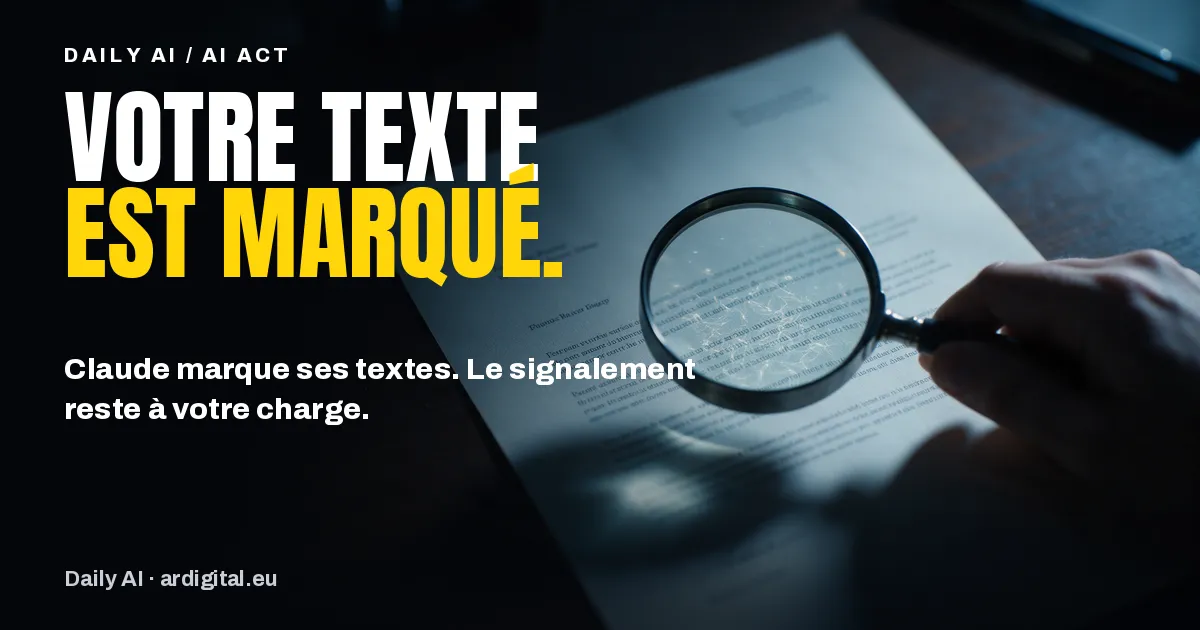
Since 3 November, three older Claude models have joined the newest ones: they slip an invisible mark into the texts they produce. This is Anthropic’s response to the AI Act. For an SME, nothing changes on screen, but a few habits change at the office.
Daily AI. Since 3 November, three older Claude models have joined the newest ones: the texts they produce carry an invisible watermark. This is Anthropic’s response to the AI Act, which requires providers to mark generated content. For your company, nothing changes on screen. But this marking settles the provider’s obligation, not yours. If you publish a realistic fake image, sound or video, you must disclose it. And a text published on a matter of public interest must be reviewed under a person’s responsibility, or flagged as produced by AI. Another point: the watermark is a signal, not proof. Never use it to accuse an employee or a candidate. Our advice: name a person in charge for each type of publication. The detail is just below.
In short: texts produced by most Claude models now carry an invisible watermark. This marking is the provider’s obligation. It does not replace yours: disclose a deepfake image, sound or video, and have a text published on a matter of public interest reviewed under editorial responsibility, or flag it.
What is happening
On 3 November 2026, the Claude Platform release notes announce that texts generated by Claude Mythos 5, Claude Opus 4.7 and Claude Sonnet 4.6 now also carry Anthropic’s text watermark. They join the list of models already marked, including all those launched since 2 August 2026, marked from release. For these three models, the rollout on Amazon Bedrock completes by 10 November, according to Anthropic’s help page.
Anthropic’s help page on the subject explains how it works. The watermark is woven into the words: you cannot see it, and it changes neither the meaning nor the quality of the answer. It applies at model level, so everywhere you use Claude: the app, Claude Code, Cowork, the API and Claude offerings from the major cloud providers. Because it is part of the text, it follows the text when it is copied and pasted elsewhere, and may survive some edits. Files created by Claude, such as a PNG or JPEG image, also receive metadata signed to the C2PA standard, called Content Credentials.
Why now? Article 50 of the AI Act requires providers of systems that generate text, images, sound or video to mark that content in a machine-readable format that is detectable as artificial. Anthropic says it has signed the European code of practice on the transparency of AI-generated content, and the law gives systems placed on the market before 2 August 2026 until 2 December 2026 to comply: this explains the gradual arrival of the older models. According to the European Commission, about 190 organisations had signed this code by the end of July 2026, among them Google, Microsoft, Mistral, Meta and OpenAI.
What it changes for an SME
Day to day, nothing visible. Your sales proposals, emails, product sheets and posts prepared with Claude look exactly as they did yesterday. No cost, no setting to change.
What changes is that these texts now carry a trace. An authority, a media outlet or a fact-checker can detect that a passage may have gone through Claude. Detection of the text watermark is for now reserved for eligible organisations, including regulators, media, researchers and companies that need to check the marking of their own Claude-produced texts to comply with the AI Act; a company in that position can register its interest through Anthropic’s form. For files, Anthropic provides a free tool, the Claude Content Checker.
Above all, this marking settles the provider’s obligation, not yours. Article 50 also places obligations on those who use AI, the “deployers” in the text of the law. Two cases concern an SME directly:
- Deepfakes. If you publish an AI-generated or AI-edited image, sound or video that resembles real people, places or events closely enough to pass as authentic, you must state that the content is artificial. For a clearly creative or satirical work, it is enough to disclose the use of AI in a suitable way, one that does not spoil the presentation of the work.
- Public-interest texts. If you publish a text produced with AI to inform the public on a matter of public interest, you must disclose it, unless it has been reviewed by a human and a person takes editorial responsibility for it.
If your SME builds Claude into its own product through the API, it must also check whether it becomes a provider within the meaning of Article 50: Anthropic invites these customers to assess their own obligations.
A concrete example. The marketing manager of an accounting firm publishes a monthly note on a tax reform, prepared with Claude. The watermark is in the text, but it tells the reader nothing. What protects the company is the review by the partner who signs the note and answers for it. We detailed the other AI Act points to check on an SME website in our article on AI Act obligations for your SME’s website.
What to plan for
| What you produce | What Claude does | What is still your responsibility |
|---|---|---|
| Email, proposal, product sheet | Invisible watermark in the text | Review before sending, as always |
| Article or public information note | Invisible watermark in the text | Human review and a named editorial lead, otherwise a mention of AI |
| Image or file created by Claude | C2PA Content Credentials in the file | Disclose any realistic deepfake to the public |
| Image or video from another tool | Nothing | Check that tool’s marking and disclose deepfakes |
Summary drawn up from Anthropic’s help page and Article 50 of the AI Act, consulted on 4 November 2026.
The watermark requires no budget. The real cost is organisational: knowing who reviews, who signs, and where the mention appears when it is needed.
The trap to avoid
The trap is believing that the watermark acts as proof, one way or the other. Anthropic says it clearly: a detected mark is a signal, not complete proof. Claude may only have corrected, translated or summarised a text written by a human, and the text may have been edited afterwards. Conversely, the absence of a mark does not prove that a text is human: a very short passage, heavily edited, translated or produced with a model that is not covered may carry nothing.
Two practical consequences. Never use a detection to accuse an employee or turn down a candidate. And do not hand your texts to tools that promise to “erase” the trace of AI: you gain a risk, not compliance, since your obligation to review and disclose stays entirely intact.
Good to know: the marking also covers older models. Anthropic’s page indicates a text watermark on its own tools for Claude Opus 4.5, Opus 4.6, Sonnet 4.5 and Haiku 4.5. If you use Claude through the API with Opus 4.6 or Sonnet 4.6 and modified generation settings, the text may carry no detectable mark.
Where to start
- Name a person in charge for each type of publication. Website, blog, newsletter, social media: one person reviews and answers for each piece of content published, even if it was prepared with AI.
- Write a one-line rule for visuals. Any realistic AI-generated image or video shown to the public carries a mention.
- Keep the original files. A screenshot, a re-save of the file or a format conversion can strip the Content Credentials: share the file as Claude created it if you want to be able to show where it came from.
- Use work accounts. A work account centralises the team’s usage: you know which AI tools your staff use to prepare your content. See our edition on personal or work account before handing a document to AI.
Our take
The watermark is good news for trust, and it asks no effort of an SME. But it shifts the question: since AI leaves a trace, the only solid defence is a clear review process. A well-trained team does not hide its use of AI, it frames it: who reviews, who signs, what is disclosed.
Frequently asked questions
What does the watermark change about the look of my texts?
Nothing. According to Anthropic, it is imperceptible and changes neither the meaning, the quality nor the readability of the answer. It adds no visible mention.
How do I turn off the watermark?
Anthropic’s help page mentions no option to turn it off. It applies at model level, whichever Claude tool is used.
Is the watermark enough to comply with the AI Act?
It meets the provider’s marking obligation. Your SME keeps its own obligations: disclosing deepfakes and flagging public-interest texts published without human review or without anyone taking editorial responsibility.
How can I check that a text comes from Claude?
Detection of the text watermark is restricted to eligible organisations. For files, the free Claude Content Checker reads the Content Credentials.
Every working dayAR Digital / Daily AI
Get Daily AI every working day.
One piece of AI news, what it changes for your business and what to do, in your inbox in the morning. Free, no commitment.