
AR Digital / Daily AI
The AI Act’s first standard: when your SME needs to deal with it
The AI Act’s first harmonised standard, EN 18286, targets high-risk AI providers. See in 5 minutes whether your SME is concerned and what to do.

Radu UleaFounder of AR Digital
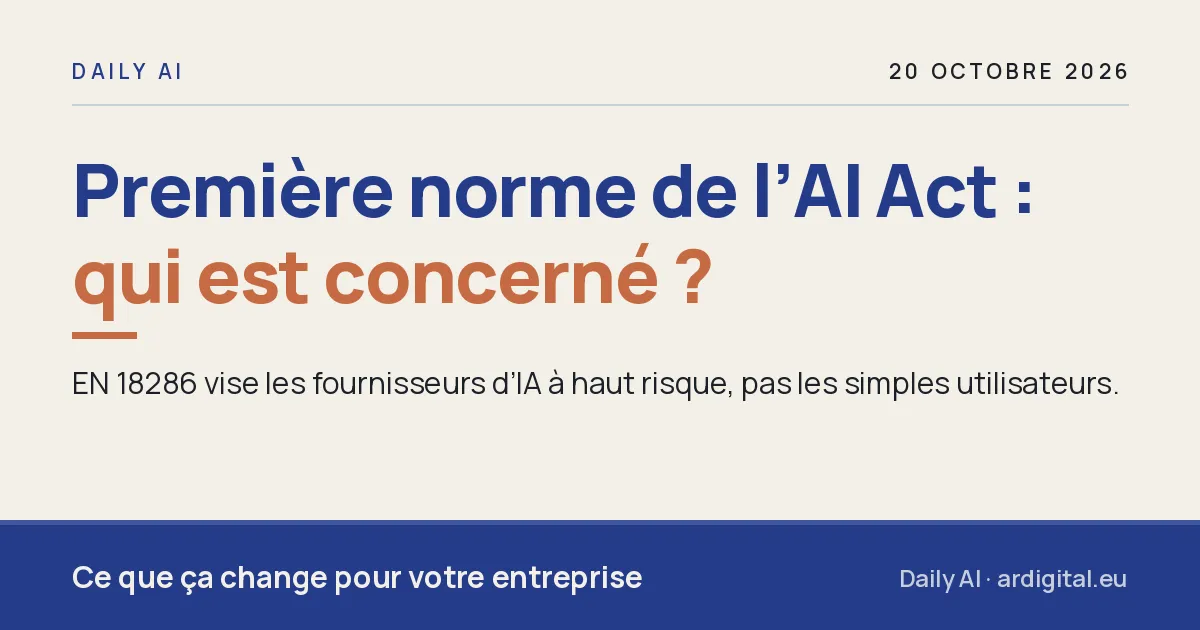
On 19 October, the European Commission announced the publication in the Official Journal of the reference to standard EN 18286, which describes the quality system expected of high-risk AI providers. Most SMEs are not targeted. Those that sell or adapt a sensitive AI tool now have a manual.
Daily AI. The AI Act’s first harmonised standard has been official since 14 October. Standard EN 18286 describes the quality system expected of providers of high-risk artificial intelligence, such as a tool that sorts job applications or assesses an individual’s creditworthiness. If you use ChatGPT or Copilot to write and summarise, it requires nothing of you. If, on the other hand, you develop this type of tool, even for your own use, if you modify it substantially or if you sell it under your name, it becomes your best protection in the event of an inspection. You have time: for these uses, the requirements will apply from 2 December 2027. In Luxembourg, the standard can be ordered from ILNAS and consulted free of charge at five locations, including the Chamber of Skilled Crafts. First step: list your uses of AI and your role for each. The detail is just below.
In short: standard EN 18286 concerns companies that provide a high-risk AI system, for example a tool for sorting job applications. If you only use ChatGPT or Copilot for your letters, it requires nothing of you. If you develop or resell this type of tool, it becomes your reference.
What happened
The European regulation on artificial intelligence, the AI Act, sets requirements for so-called high-risk AI systems. It does not say in detail how to meet them: that work falls to harmonised standards, drafted by the European standardisation bodies CEN and CENELEC at the Commission’s request.
The first of these standards is now official. Implementing Decision (EU) 2026/2274, signed on 12 October 2026 and published in the Official Journal on 14 October, adds standard EN 18286:2026 to the list of harmonised standards under the AI Act. The Commission announced it on 19 October.
Its subject: the quality management system that Article 17 of Regulation (EU) 2024/1689 imposes on high-risk AI providers. A provider that applies it benefits from a presumption of conformity for the requirements it covers. In other words, in the event of an inspection, the provider does not have to justify its own method: for the requirements it covers, it is enough to show that it has applied the standard correctly.
According to the Commission, the standard is built around the life cycle of the AI system rather than around the organisation. It is designed to be added onto an existing system, such as ISO 9001 or ISO/IEC 42001, rather than to replace it.
What it changes for an SME
It all depends on your role. The AI Act distinguishes the provider, who develops an AI system and places it on the market or puts it into service under its name, including for its own use, and the deployer, who uses it in its business. Standard EN 18286 is addressed to providers, and only for uses classed as high-risk.
These uses are listed in Annex III of the regulation: for example recruitment and selection of candidates, assessing the creditworthiness of natural persons, access to education or the assessment of pupils. Writing sales proposals, summarising meetings or replying to customers with a chatbot is not among them.
Three situations emerge:
- You use consumer tools to write, translate or summarise: the standard does not concern you. Your obligations mainly cover your teams’ AI literacy and, in some cases (deepfakes, public information texts published without human review), transparency: that is the subject of our article on the AI Act and team training.
- You use, without modifying it, a high-risk tool bought from a vendor, for example software that ranks job applications: you are a deployer. The standard does not apply to you, but it gives you a grid for questioning your supplier.
- You develop such a tool, including for your own internal use, you modify it substantially or you sell it under your name: you are a provider. EN 18286 becomes the surest way to prove your compliance.
What to plan for
The timetable leaves time. Regulation (EU) 2026/1744, known as the digital omnibus on AI, has postponed application of the requirements: to 2 December 2027 for Annex III systems, and to 2 August 2028 for high-risk systems built into regulated products under Annex I, such as machinery or medical devices.
A quality system is not built in a quarter: you need to describe how the system is designed, tested, documented, monitored after it is placed on the market, and how incidents are escalated. For a provider, starting in 2026 is not premature.
Good news for small organisations: since the omnibus, Article 17 states that this quality system is proportionate to the size of the provider, in particular for an SME or a start-up, and Article 63 allows SMEs with no partner or linked enterprise to apply certain elements in a simplified way, which the Commission is to specify in guidelines. The level of protection required stays the same.
On direct cost, the standard is sold by the standardisation bodies. In Luxembourg, it can be ordered from ILNAS, the national standardisation body, which grants start-ups a 50% reduction on request. It can also be consulted free of charge in read-only mode at five locations, including the Chamber of Skilled Crafts at Kirchberg.
To remember: the standard is not mandatory in itself. A provider can prove its compliance in another way, but it will then have to demonstrate everything alone, without the presumption of conformity.
The trap to avoid
The trap is thinking you are a simple user when you have become a provider. Article 25 of the AI Act provides that a deployer takes on the provider’s obligations if it puts its name or brand on a high-risk system, if it modifies it substantially, or if it repurposes a general-purpose tool for a use classed as high-risk.
In practice, a recruitment agency that assembles a candidate pre-screening assistant from a model on the market, then offers it to its clients under its name, is no longer a simple user. It is up to the agency to maintain the quality system.
Where to start
- List your uses of AI, tool by tool, and spot those that touch on recruitment, credit, education or another Annex III area.
- Determine your role for each: user of a tool you bought, or provider of a tool that you develop, modify substantially or sell under your name.
- If you are the deployer of a high-risk tool, ask the vendor whether it follows EN 18286 and how it documents its updates.
- If you are a provider, consult the standard, compare its content with your current organisation and plan the gap before December 2027.
For the rest of your obligations, our article on the points to check on your SME’s website since 2 August 2026 remains up to date.
Our take
This standard is good news, even for those it does not target: it turns a vague obligation into a checklist. For the great majority of SMEs, the priority lies elsewhere, in mastering everyday tools. But if you sell a service that sorts, scores or ranks people with AI, now is the time to open the file, while the timetable leaves some room.
Frequently asked questions
Does an SME have to apply standard EN 18286?
No. No harmonised standard is mandatory in itself. It concerns high-risk AI providers, who can apply it to benefit from a presumption of conformity with Article 17 of the AI Act.
I use ChatGPT in my company: does this standard concern me?
Not through this standard. Writing, translation or summarising is not classed as high-risk. Your obligations mainly cover your teams’ AI literacy and, in some cases, such as publishing deepfakes, transparency.
What are the application dates for high-risk AI?
Since the digital omnibus regulation on AI, 2 December 2027 for Annex III systems, and 2 August 2028 for those built into regulated products under Annex I.
Where can the standard be consulted in Luxembourg?
It can be ordered from ILNAS. It can also be consulted free of charge in read-only mode at five locations listed by Guichet.lu, including the Chamber of Skilled Crafts at Kirchberg.
Every working dayAR Digital / Daily AI
Get Daily AI every working day.
One piece of AI news, what it changes for your business and what to do, in your inbox in the morning. Free, no commitment.